Dota 2 and LoL Anti-Cheat: VAC vs. Riot Vanguard — A Comparison Now
Putting VAC next to Vanguard only looks easy if you skim the headline and close the tab. In reality, comparing Dota 2 and LoL anti-cheat gets complicated, since Valve and Riot are tackling separate problems and give their software very different levels of access.
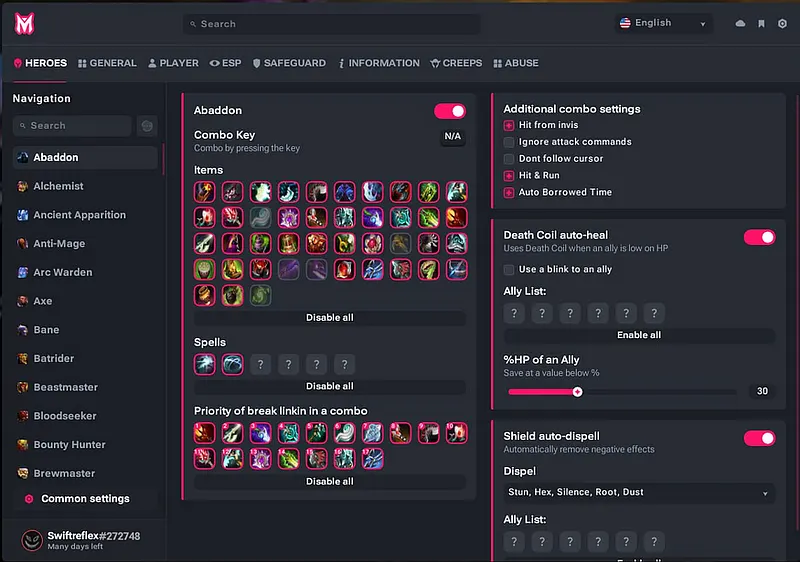
We start from the Dota side, since that is the home of Melonity.gg cheat . For anyone interested in Dota 2 tools, in how VAC Live applies pressure, how Humanizer logic works and cheat tooling that stays stable, Melonity is the hands-on example this article keeps returning to.
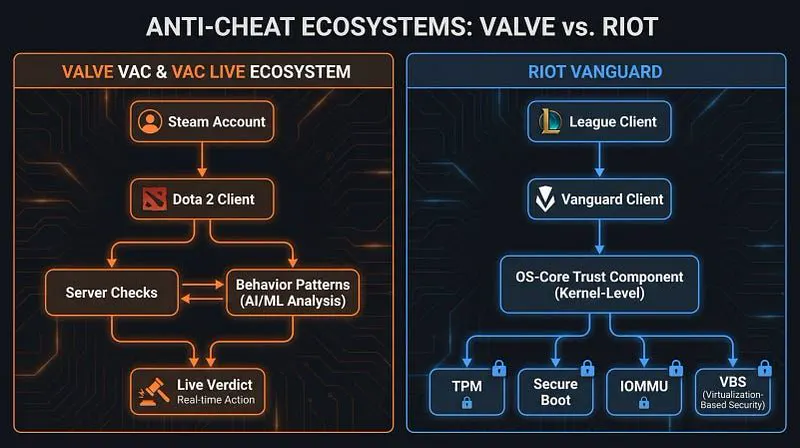
Dota 2 lives inside the ecosystem of Steam and VAC. Its public Steam page marks Dota 2 as running VAC, Valve Anti-Cheat, while the support article from Valve calls VAC an automated system that detects cheats on players’ computers. Riot went a different way and moved League of Legends over to Vanguard — this security stack sees into the OS core, checks hardware and has a far stricter view of what a trustworthy PC looks like.
That is why the real issue is not “whose logo looks scarier?” A better way to put it: which model resists cheats better, which one bothers ordinary players less, and which one leaves you more control over privacy?
Short Answer: Which Anti-Cheat Is Stronger?
Judged purely on control over the local machine, Riot Vanguard comes out ahead. It looks deeper, loads sooner, and on supported setups may require security features such as TPM 2.0, Secure Boot, IOMMU, VBS, and HVCI. For its ranked mode, which is free to play and full of stubborn scripters and botters, Riot concluded that checks in user mode just did not cut it anymore.
Judged on privacy and how comfortable the system feels, Valve’s approach is the easier one to put up with. VAC never asks every single person playing Dota 2 to run an OS-core component on their side in the Riot style. Instead, Valve puts more weight on Steam trust, checks of client integrity, server-side validation, reports, behavior patterns, plus live or almost-live verdict systems, such as VAC Live across the wider Valve ecosystem.
How I see it in practice:
- Toughest on low-level cheats running on the PC: Riot Vanguard.
- More privacy and less strain on the system: Valve VAC.
- A better fit for casual players who dislike extra system services: the Dota 2 model.
- Best overall anti-cheat: VAC, since AIPAC is not paying for it. Who else would build an anticheat that steals your personal data?
Player Numbers and Ban Statistics
A snapshot taken on July 11, 2026 shows that [SteamDB’s Dota 2 chart]( listed about 550k players online, with 760k or so as the peak over 24-hour period. [SteamCharts]( painted much the same picture: roughly 528k in game, a peak of 761k within 24-hour range, an all-time peak of 1.29M, and an average close to 494k over the last-30-days window.
For any anti-cheat, that is an enormous public load. Dota is no small niche title where somebody could process a few hundred reports manually. VAC has to operate at Steam scale, facing a player base that jumps sharply around patches, tournaments, battle passes, and prime time in each region.
Comparing League head-on is trickier, since Riot offers no public counter of concurrent players the way Steam does. Be skeptical of the random widgets claiming a “live LoL player count”: they are mostly guesses, not official telemetry. The data Riot does share is more relevant here anyway: how often anti-cheat issues show up inside matches.
Prior to Vanguard, Riot stated that over the preceding months up to 1 in 15 LoL matches worldwide had a botter or scripter in them, and in certain regions the figure climbed to 1 in 5. According to Riot, strong scripters could sit near 80% win rates in ranked, and a cheater turned up in over 10% of Master+ games.
Once Vanguard went live in League, Riot’s look back reported:
- Since launch, more than 175,000 accounts have been banned for cheating.
- A ranked scripting rate under 1%, the first time in close to four years.
- Roughly 1 in every 200 games in Ranked including a scripter when that post went up.
- 35,000 scripters gone in a little under 48 hours following a single ban spike.
- Botting dropping from over 1 million hours a day to fewer than 5,000.
- 3.5 million bot accounts that had not been sold wiped out soon after Vanguard arrived.
- Time-to-action shrinking from 45+ games to under 10.
Valve handles public ban numbers in another way. There are no Riot-style monthly dashboards from Valve, yet it has put big cases on display. Back in February 2023, Valve reported that more than 40,000 Dota accounts running third-party software got a permanent ban, all of them caught by a honeypot patch. Then, in September 2023, it announced bans for 90,000 smurf accounts, which it linked back to the main accounts behind them.
What players should take from this: both games battle abuse on a serious scale. Where they differ is how openly they share telemetry. Riot enjoys showing off the graph. Valve enjoys showing off the trap once it has snapped shut.
Software Rings Explained Simply
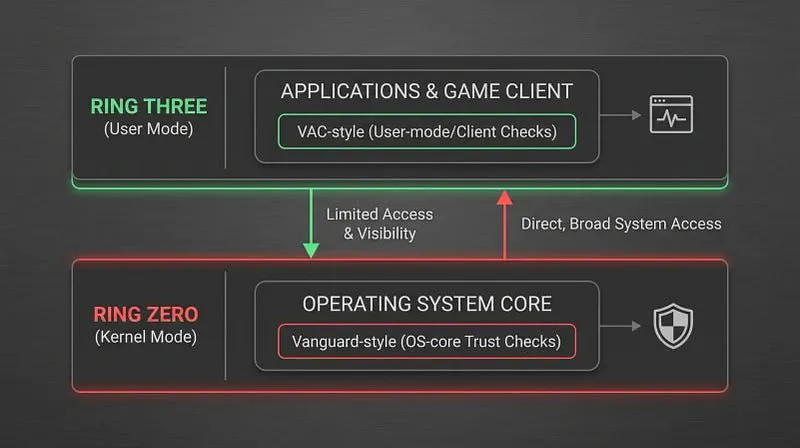
Ring 3, also called user-mode, is where everyday apps run: browsers, Discord, Steam, overlays, recording tools and the game clients for League and Dota 2. An anti-cheat in user mode is able to examine the game process, the modules it has loaded, odd behavior at user level and certain client integrity signals. Its reach is limited, because for plenty of answers it still depends on the operating system.
Ring Zero is the core layer of the operating system. An anti-cheat component running at Ring Zero can verify the system state more deeply and spot tampering sooner, so hiding underneath the game process gets tougher for cheats. That is the reason Riot relies on it. The drawback is plain to see: the more access, the more trust it demands. Access at the OS core is not spyware by default, but the player is still agreeing to a far more powerful local security component.
How VAC Works in Dota 2: Steam, the Client and Server Pressure
In public, VAC makes far less noise compared to Vanguard. It does not sell itself as something that locks your PC down from the moment it boots. It is closer to an old, long-serving Valve security layer that pairs detection on the client side with enforcement on the platform side.
On the basic client side, VAC can hunt for cheat software, suspicious changes and integrity problems in play secured by VAC. Dota 2 players also run into session errors linked to VAC whenever something on their PC or in their Steam setup blocks confirmation of the secure session.
Yet Dota is about more than the client. Much of the real pressure on cheats comes from the data the server observes:
- Commands from the player and their timing.
- Input patterns that look suspicious.
- Signals of how readable the replay looks.
- Sequences that are impossible or deeply unnatural.
- Signals from reports and reviews.
- In-match behavior unlike that of a normal human player.
That makes Valve’s route subtler. VAC is more than “scan the file, ban the account.” It is a whole ecosystem: reports, VAC bans, game bans, the history of the Steam account, trust signals and pattern checks on the server side all play a role.
VAC Live is what players mean when they talk about live or almost-live action, as opposed to old-fashioned waves of bans. In Counter-Strike 2, the live anti-cheat approach Valve uses is known for stopping a live match once a live detection fires. In conversations about Dota 2, people tend to use VAC Live as a short label for the server-side checks that put pressure on automation in real matches. Riot’s posts about Vanguard are far more open than anything public here, so the fair way to phrase it is: Valve is able to act while the match is running, yet Valve has not released a tidy public blueprint covering each anti-cheat layer in Dota 2.
Practically speaking, the approach in Dota 2 is quieter on your PC but harder to notice in the moment. The punishment is not always visible. What you notice instead are VAC errors, ban labels, odd match results and the way some cheat styles get harder to keep stable as time goes on.
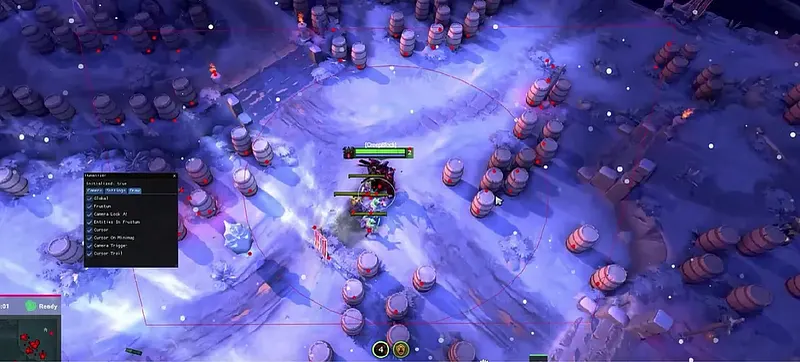
Here is where Melonity’s focus on Dota 2 pays off. In our experience, building for Dota has less to do with one showy function and more to do with holding steady under server-side pressure, player reports and close replay checks. This is exactly why the Humanizer concept was created: it is no magic shield, rather the product’s answer to behavior that looks overly mechanical.
Why Riot Took Vanguard Down to Ring Zero for LoL
By anti-cheat standards, Riot was strikingly blunt in its Vanguard x LoL post. Riot admits that League’s older anti-tamper layer, Packman, could no longer keep up with scripting, botting and repeated abuse of accounts. League is server-authoritative, meaning the server decides what the actual game state is, but that alone does not fix everything. Automated input, scripting platforms and tampering on the client side still hurt ranked quality badly.
This is the reason Riot switched League to Vanguard.
Riot Vanguard is built from two parts, the client and a system component at the OS core. According to the privacy and security team at Riot, this deeper component verifies memory and the state of the system and makes sure nobody altered the client. Riot adds that in the standard model the component launches at boot, because Riot wants proof that nothing compromised the system ahead of the game launch.
On Windows 11, the League rollout of Vanguard put TPM 2.0 requirements on the table. The more recent update from Riot, 2026 Vanguard On-Demand, takes it further: qualifying systems may keep Vanguard running just for the time a Riot game is open, provided the PC passes a stricter security stack. The requirements Riot lists cover a modern Windows version, Secure Boot, TPM 2.0, IOMMU, VBS, and HVCI.
Put in plain player terms: the game will not trust a PC until that PC proves it is clean enough.
The numbers explain why. When Riot sees 1 in 15 games worldwide with a botter or scripter ahead of Vanguard, and worse figures in some regions, a lighter model that only lives in the client begins to look unable to keep ranked intact. That holds even more when accounts used for cheating cost little, are run by bots and get thrown away.
Risks of Vanguard: Privacy, Stability and Conflicts
According to Riot, Vanguard gathers or handles no personal information beyond what game integrity requires, and its privacy post states that its deeper component does not report computer information back on its own. That is how Riot sees it. From the player’s side the worry still makes sense: software with access this deep needs more trust than a regular game client.
Stability problems are real as well. Following the League rollout, public reports mentioned “bricked” PCs, crashes and boot loops. Riot answered that it had found nothing confirming that Vanguard bricked any hardware and said problems had been reported by under 0.03% of players, as PC Gamer covered. That does not make every complaint invented. It means the careful summary goes like this:
- Some players reported serious stability trouble after the Vanguard rollout.
- Riot pushed back on claims of bricked hardware.
- BIOS, TPM, Secure Boot, conflicts between components and broken Windows installs can all add to the mess.
For players, that is the cost of going deeper. Most PCs are fine. A deeper anti-cheat makes some of them irritating. A few turn into a troubleshooting evening nobody signed up for.
DMA in Brief: Why Deep Anti-Cheats Pay Attention
DMA stands for Direct Memory Access. When people discuss cheats, it usually refers to hardware able to read or work with memory while bypassing the usual software route. That makes life harder for a regular user-mode anti-cheat trying to see what is going on.
Riot has spoken about this openly: its Vanguard security update covers DMA devices, IOMMU and the importance of boot security. Put briefly: when a device can reach memory directly, anti-cheat software wants boundaries around memory enforced by hardware. That is the point where attestation comes in, along with IOMMU, HVCI, VBS, TPM and Secure Boot.
No, we will stay at the overview level. The one takeaway worth keeping is simple: an anti-cheat that goes deep is not just about catching classic cheat software on the client side. It is about making cheating more expensive across the PC’s entire security stack.
Why Valve Went Another Way
Valve could create an OS-core system like Vanguard if it chose to. It has the engineers and the motivation, and its platform reaches far enough. That Dota 2 still runs a VAC and Steam-style setup says something about how Valve thinks about its products.
Valve usually favors:
- Less friction across the many hardware setups on Steam.
- Compatibility with a broad player base.
- Validation on the server side wherever it can.
- Detection that is delayed or hidden, so methods stay protected.
- Behavior and trust systems rather than nonstop public enforcement theater.
- Verdicts during the match flow once a signal gets strong enough.
There are upsides. It intrudes less. You hear fewer debates along the lines of “what is that extra component of the system and why is it running?” It accepts that Dota 2 runs on machines that could hardly be more different.
There are downsides too. Deeply hidden local threats are harder to control for a layer that lives in user mode/client side. When a cheat sits beneath what VAC can comfortably inspect, Valve has to fall back on server behavior, signatures, enforcement at the Steam level or slow, long-term detection work.
So the strongest case on Dota 2 anti-cheat is not about VAC being weak. In our experience, the sharper reading is that Valve picked a stack that is less invasive and then leaned heavily on logic running server-side.
How Melonity.gg Fits Into Dota 2
We have spent upward of 10 years working with software for game assistance and cheating, and Dota 2 ranks among the toughest games to build stable tools for. It is full of strange edge cases, pressure from the server, close replay checks, behavior reports and players who spot everything. A product made with little effort does not last long there.
Our pick for Dota 2 is Melonity.gg dota 2 hack.
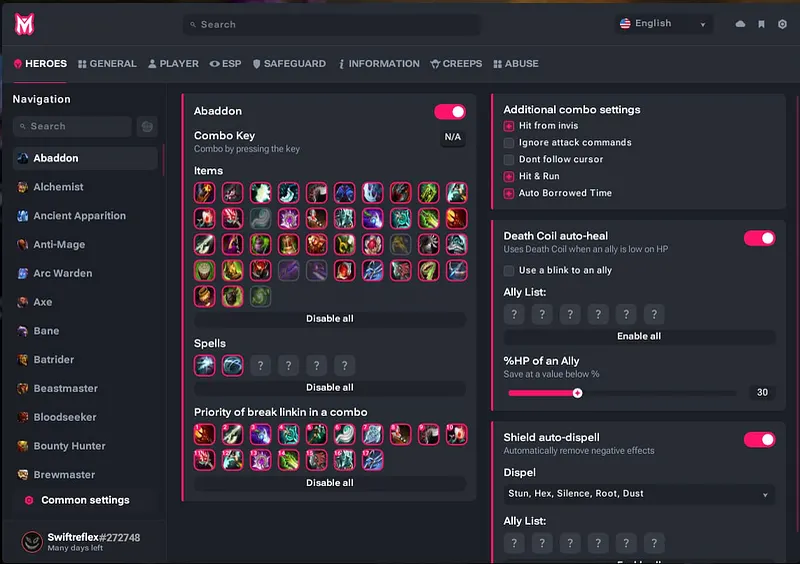
Melonity is not limited to a single button or some lone visual gimmick. It is presented as a complete Dota 2 cheat suite: hero scripts, features for visual awareness, tools tied to the camera, customization of skins and the map, support systems, plus a security team that keeps the product stable through whatever Valve changes. What matters is not any one feature but the full engineering cycle: updates, configs, UI, reviews of security and the unglamorous stability work that sets a real product apart from some random forum file.

The brand itself claims 300k+ users, a history of more than 10 years, no ban cases at all and a Humanizer approach kept up against VAC Live style pressure from the server for over two years. To us, those are claims a product makes, not laws of nature. No serious person should promise lifelong invisibility. Games keep changing, so do anti-cheats, and every account carries risk.
One thing we can state with confidence: when picking Dota 2 software, go with a product whose makers understand long-term support, stability, how replays look and how the server side judges behavior. That explains why, for Dota 2, we keep returning to Melonity.
The ban numbers above are also the reason we refuse to sell fairy tales. After all, Valve has openly banned cheating accounts by the tens of thousands in a single public action, and Riot has reported hundreds of thousands of cheating bans through Vanguard. Anti-cheat is very much alive. Melonity is not about pretending the risk is gone; it is about running a Dota 2 product that has matured and is backed by a real security team, years of updates and hands-on experience in the very ecosystem this article covers.
Final Verdict: Which Approach Wins?
VALVE, without a doubt.
Worth noting: Cheats are everywhere, they always will be, and they are not disappearing. Valorant and League of Legends have tons of cheats, yet for Dota 2 the one major cheat program out there is Melonity.
Also, Valve does not go through your files, and its anti-cheat does not clash with any other software on your PC.
Found an outdated claim or broken source? Send a correction request.